
BLOG

- HOME
- BLOG
- Related Knowledge
- What fireproof panels are available? Panel partitions are the most recommended.
What fireproof panels are available? Panel partitions are the most recommended.
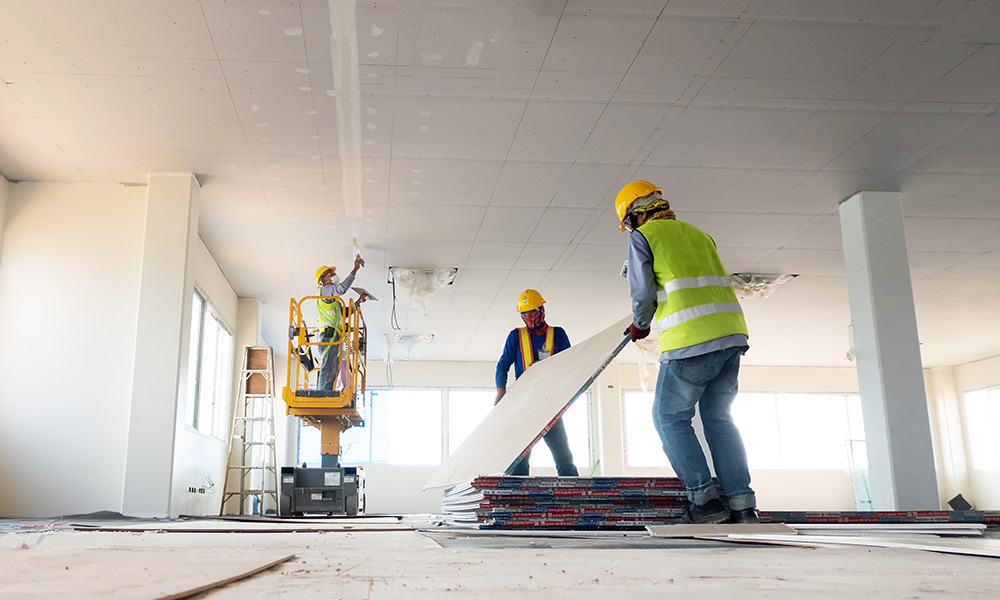
There are often news reports of fires on television. Fire incidents are something no one wants to encounter. However, even if you are careful with fire usage, you cannot guarantee that your neighbors are equally cautious. Today, we will introduce fire-resistant building materials—fireproof boards. Their advantages include being difficult to ignite, producing less smoke or gas, and reducing the risk of combustion during fire incidents. Whether you are constructing an office, factory, or residential building, it is important to understand fireproof boards!
Why Use Fire-Resistant Materials?
We recommend using fire-resistant materials whether the building is for personal or commercial use. By using fireproof board materials, the amount of combustible substances is reduced. If a fire accidentally occurs, the fire-resistant properties of interior materials can help extinguish the flame on its own or slow down the spread of fire, allowing occupants more time to escape and seek safety. Fire-resistant materials also help prevent structural damage caused by fire, reducing property loss.
〈Related Reading: What Is Fire Zoning? Introduction to 4 Common Zoning Types〉
What Is a Fireproof Board?
A fireproof board is a type of decorative fire-resistant building material. Through special manufacturing processes, its advantages include being hard to ignite or spread fire, producing little heat or smoke, and not generating toxic gases like typical building materials do when burned. Fireproof boards are commonly used in furniture, cabinets, staircases, and also widely applied in partition walls for offices and factories.
Types of Fireproof Boards
Common fireproof boards include cement board, magnesium oxide board, gypsum board, calcium silicate board, and sandwich panels. Below is a detailed introduction:
Cement Board
Fiber cement board is one type of first-grade fire-resistant board. Common thickness specifications include 6mm and 9mm. Since fiber cement boards do not deteriorate from long-term moisture exposure and typically have higher strength than calcium silicate boards, they are commonly used as lightweight partition panels for tiled surfaces or walls requiring grouting.
Magnesium Oxide Board
Magnesium oxide board is a first-grade fire-resistant material made primarily of magnesium oxide and magnesium chloride, reinforced with fiberglass mesh. Magnesium oxide boards easily absorb moisture and deform, are not good at moisture resistance, and offer poor finishing quality, but they are a cheaper type of fireproof board.
Gypsum Board
Gypsum board is a first-grade fire-resistant material with gypsum as the main component. It contains crystalline water that enhances its fire resistance. Common thickness ranges from 9–25.4mm. Types include reinforced gypsum board, standard gypsum board, and moisture-resistant gypsum board. Gypsum boards are stable and suitable for interior partitions of homes, offices, hotels, kitchens, and general buildings.
Calcium Silicate Board
Calcium silicate board is a first-grade fire-resistant material made mainly from inorganic substances. Common thickness ranges from 6–9mm. Its features include adequate strength and moisture resistance. It is often used for interior walls, ceilings, partitions, or areas prone to dampness and mold.
Sandwich Panel
Sandwich panels are first-grade fire-resistant building materials and have recently become popular for partition construction. Their structural frame is primarily steel, with types including PU foam panels, rock wool panels, and honeycomb paper panels. They are easy to clean, aesthetically pleasing, and highly durable. Under normal conditions, they can last over ten years. Compared with other fireproof boards, their greatest advantage is the ability to be reused when relocating or modifying partition layouts. Sandwich panels are suitable for cleanrooms, factory partitions, and office partitions.
〈Related Reading: What Are Sandwich Panels? A Quick Guide to 4 Partition Methods〉
Comparison Table of Fireproof Board Types
| Sandwich Panel | Gypsum Board | Magnesium Oxide Board | Calcium Silicate Board | Cement Board | |
|---|---|---|---|---|---|
| Strength | Excellent | Average | Good | Excellent | Average |
| Moisture Resistance | Excellent | Good | Poor | Good | Excellent |
| Flame Resistance | Excellent | Excellent | Excellent | Excellent | Excellent |
| Peeling Resistance | Excellent | Average | Poor | Good | Excellent |
| Finishing Quality | Excellent | Good | Poor | Good | Excellent |
| Reusability | Reusable when relocating or expanding | No | No | No | No |
| Price | To be filled | To be filled | To be filled | To be filled | To be filled |
What Are Fire Resistance Grades? Introduction to the 3 Fire Resistance Levels
Fireproof board fire-resistance grades cannot be identified by appearance. Before construction, verify with contractors whether the materials have certificates issued by the Bureau of Standards, Metrology and Inspection, such as: “Inspection Certificate,” “Commodity Certification Registration,” or “Approval Notice for New Building Technology, Methods, Equipment, and Materials” issued by the Ministry of the Interior. Below is a summary based on the Construction and Planning Agency’s Building Technical Regulations, helping you understand the classifications:Non-Combustible Materials (Grade 1 Fire Resistance)
These include concrete, bricks or hollow bricks, tiles, stone, steel, aluminum, glass, fiberglass, mineral wool, ceramics, mortar, lime, and other materials recognized as Grade 1 fire-resistant by the central authority. They do not burn, melt, deform, or produce harmful gases under fire or high temperatures, with a smoke density index below 30.Fire-Resistant Board (Grade 2 Fire Resistance)
Refers to wood wool cement board, fire-resistant gypsum board, and other materials recognized as Grade 2 fire-resistant. During a fire, they show minimal combustion and burn at a very slow rate. The smoke density index is below 60 and does not deform, melt, or crack.Fire-Resistant Materials (Grade 3 Fire Resistance)
Includes fire-resistant plywood, fire-resistant fiberboard, fire-resistant plastic board, gypsum board, and other materials recognized as Grade 3 fire-resistant. They exhibit slight combustion during fire incidents, burn slowly, and have a smoke density index below 120 without deformation, melting, or cracking.What Are Fire Resistance Grades? Introduction to the 3 Fire Resistance Levels
Fireproof board fire-resistance grades cannot be identified by appearance. Before construction, verify with contractors whether the materials have certificates issued by the Bureau of Standards, Metrology and Inspection, such as: “Inspection Certificate,” “Commodity Certification Registration,” or “Approval Notice for New Building Technology, Methods, Equipment, and Materials,” to ensure compliance. Below is the summarized information from the Building Technical Regulations:Non-Combustible Materials (Grade 1 Fire Resistance)
These materials include concrete, bricks or hollow bricks, tiles, stone, steel, aluminum, glass, fiberglass, mineral wool, ceramics, mortar, lime, and others recognized as Grade 1 fire-resistant. They do not burn, melt, deform, or produce harmful gases under high temperatures. The smoke density index is below 30.Fire-Resistant Board (Grade 2 Fire Resistance)
Refers to wood wool cement board, fire-resistant gypsum board, and other materials recognized as Grade 2 fire-resistant. They show very minimal combustion and burn extremely slowly. The smoke density index is below 60 and does not deform, melt, or crack.Fire-Resistant Materials (Grade 3 Fire Resistance)
Includes fire-resistant plywood, fire-resistant fiberboard, fire-resistant plastic board, gypsum board, and similar materials. They show slight combustion, burn slowly, and have a smoke density index below 120 without deformation, melting, or cracking.
Comparison Table of Fire Resistance Grades
| Non-Combustible Materials (Grade 1) | Fire-Resistant Board (Grade 2) | Fire-Resistant Materials (Grade 3) | |
|---|---|---|---|
| Combustion Behavior | Unlikely to combust | Very slight combustion | Minor combustion |
| Smoke Density | Low smoke and gas generation; smoke density below 30 | Smoke density below 60 | Smoke density below 120 |
| Deformation, Melting, Cracking | No abnormalities | No abnormalities | No abnormalities |
| Material Testing Definition | Meets CNS 6532 A3113 Surface Test (10 points) Substrate Test (20 points) |
Meets CNS 6532 A3113 Surface Test (10 points) |
Meets CNS 6532 A3113 Surface Test (10 points) |
Advantages and Disadvantages of Fireproof Boards
Advantages
The primary advantage of fireproof boards is their outstanding fire resistance. They can withstand high temperatures for a period of time without releasing harmful gases and effectively slow down fire spread. Many fireproof boards are also moisture-resistant, corrosion-resistant, and wear-resistant, increasing durability. Modern fireproof boards come in various colors and patterns to match different interior styles and are suitable for offices, schools, hospitals, and other areas requiring high fire safety.
Disadvantages
Compared to standard building materials, high-quality fireproof boards are more expensive due to their specialized production processes and materials. Structurally, fireproof boards tend to have a flatter appearance, making them more suitable for simple interior design styles.
Applications of Fireproof Boards
Fireproof boards offer excellent fire resistance, sound insulation, and thermal insulation. They are commonly used in commercial buildings, office spaces, schools, medical facilities, residences, and industrial environments. They appear in firewalls, fire partitions, kitchen cabinets, factory areas, warehouses, and production sites that handle flammable materials.
〈Related Reading: Office Partition Methods — Complete Guide and Comparison〉
Conclusion
Today we introduced five types of fireproof boards, comparing their strength, moisture resistance, flame resistance, peeling resistance, finishing quality, and reusability. Based on different spatial needs, each material has its advantages. However, overall, we most recommend sandwich panels for fireproof partitions. They excel in fire resistance, sound insulation, thermal insulation, impact resistance, moisture resistance, and load-bearing capacity. As a professional sandwich panel partition contractor with extensive experience and a full-service team, we provide complete after-sales support. If you require construction services, please contact us.


Johnson
The author possesses years of practical engineering experience and project collaboration skills, excelling at solving problems with clear logic and reliable technical thinking. Focusing on system planning, engineering quality and efficiency optimization, the author is committed to providing stable and trustworthy engineering content and perspectives with professionalism and integrity.
Article Classification
Recent Articles
- What does interior decoration include? A must-read guide before interior renovation!
- How to Build Cleanroom Partitions? Cold Storage Panel Experts Guide You Through Cleanrooms
- How to renovate a bathroom? Learn about bathroom renovation projects, costs, and precautions in 5 minutes!
- How to install construction fencing in compliance with regulations? Understand key specifications and types of fencing in 3 minutes!
- What is a modular house? We'll explain its 5 major advantages and different types!