
BLOG

- HOME
- BLOG
- Related Knowledge
- How to build partition walls? A comparison of 8 partition construction methods.
How to build partition walls? A comparison of 8 partition construction methods.
Oct 25, 2022
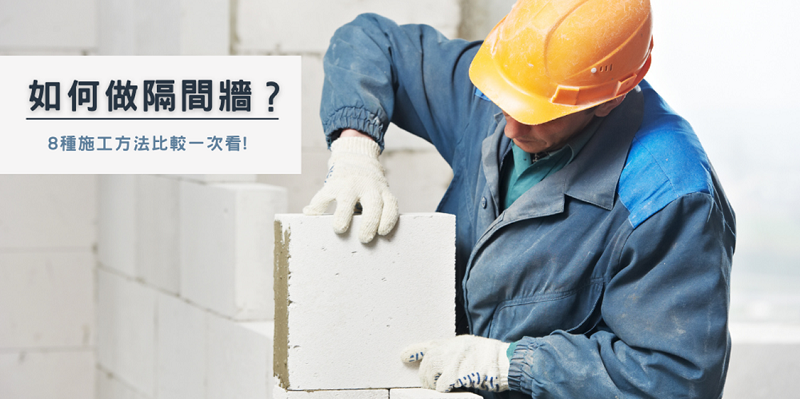
As housing prices continue to rise, our living spaces become increasingly smaller. Without proper space planning by an interior designer, the living environment may feel inconvenient. Partition walls are part of interior renovation; they not only allow for efficient use of space but also extend the lifespan of the interior by choosing different wall construction methods according to purpose. What types of partition walls exist, and how should you choose the right one? Let's explore together.
〈Extended Reading: How to Build Cleanroom Partitions? Expert Guide〉
〈Extended Reading: What Is Masonry Work? 5 Standard Procedures Explained〉
〈Extended Reading: What Fireproof Boards Are Available? Sandwich Panels Recommended〉
〈Extended Reading: How to Build a Soundproof Wall? Material Selection Guide〉
〈Extended Reading: Where Can Light Partitions Be Used? Materials & Price Guide〉
〈Extended Reading: Interior Design vs. Renovation—What’s the Difference?〉
〈Extended Reading: Office Partition Methods: Complete Comparison Guide〉
〈Extended Reading: What Does Interior Renovation Include? Pre-Renovation Must-Read Guide〉
8 Common Partition Wall Construction Methods
Partition wall construction can be divided into “wet construction,” which uses mainly cement; and “light partition construction,” which uses little or no wet materials.Wet Construction
Wet construction includes red brick walls and RC walls, both requiring large amounts of cement mixtures. These materials share characteristics such as heavy weight and solid structural strength.1. Red Brick Wall
Red brick walls are traditional partition materials known for excellent sound insulation, fire resistance, and waterproofing. The structure is stable and supports strong wall-mounted loads. However, red bricks are not earthquake-resistant and add heavy load to the building, so they are typically used in structurally stable areas. Red brick partition wall construction involves “bricklaying,” “rough plastering,” and “waterproofing.” The process is time-consuming and costly, commonly used in bathrooms and kitchens where moisture is prevalent.- Suitable Building Types: Townhouses.
- Construction Steps:
- Stack red bricks and apply cement mortar to build part of the wall.
- Wait 3–5 days for drying before building the next layer.
- After completion, apply rough plastering to level uneven brick surfaces with cement mortar.
- After drying, apply waterproof paint.
2. RC Wall
RC stands for Reinforced Concrete, commonly known as steel-reinforced concrete. RC wall construction includes placing steel bars, installing formwork, pouring concrete, and removing the formwork after curing. It requires significant manpower, and the wall must dry and harden, resulting in higher time and cost. RC walls provide excellent sound insulation, fire resistance, and earthquake resistance, and are structurally strong enough to bear heavy loads. However, like red brick walls, they impose heavy weight on the structure. Because RC walls are solid and dense, modifying internal pipes later requires chiseling, making them typically used for exterior walls or inter-unit walls.- Suitable Building Types: Apartment exterior walls, interior walls, partition walls
- Construction Steps:
- Secure steel bars.
- Install formwork around the steel bars.
- Pour concrete.
- Remove formwork after drying.
Light Partition Construction
Wet construction adds unnecessary load to buildings and affects structural safety. Light partitions solve this issue by reducing weight. Although they bear less load, they improve earthquake resistance and construction efficiency, meeting many partitioning needs.3. Wet Lightweight Grouting
Wet lightweight grouting uses a light steel frame as the structure and cement boards as panels. After creating grouting holes in the cement boards, lightweight concrete mixed with cement mortar and foam beads is poured in and air-dried for 1–2 days. This method is fast, fire-resistant, moderately earthquake-resistant, offers good sound insulation, and is strong enough to support heavy loads.- Suitable Building Types: Apartments, office partitions
- Construction Steps:
- Secure the light steel frame.
- Install cement boards around the frame.
- Create grouting holes on the board and pour lightweight concrete to dry.
4. Dry Light Steel Frame
After the contractor installs the light steel frame, sound-absorbing cotton is added and sealed with boards. This construction is fast, requires minimal cutting, and is cost-efficient. Although fire-resistant, it is not waterproof or strongly earthquake-resistant. Its sound insulation is weaker than cement or brick walls. Wall-mounted items must be hung directly on the steel frame. It works best for simple, fast, and low-cost partitions.- Suitable Building Types: Office building partitions
5. Carpentry (Wood Frame Partition)
Wood frame partitions are similar to dry steel framing: install wooden framework, fill with sound-absorbing cotton, then seal with boards. Materials are cost-effective and tiles can be added for strength. Fast, lightweight, and moderately durable—however, wood is not fire-resistant, water-resistant, earthquake-resistant, or load-bearing. Therefore, fire-resistant boards are commonly used.- Suitable Building Types: Office building partitions
6. White Brick Wall
White bricks (ALC autoclaved lightweight concrete blocks) weigh only one-third of red bricks, offer moderate earthquake and fire resistance, and dry quickly with special adhesive. A job that takes red bricks one month can be completed in one week with white bricks. However, white bricks absorb water and have weak load-bearing capacity, requiring expansion screws to prevent cracks.- Suitable Building Types: Townhouse partitions, apartment partitions
7. Lightweight Aggregate Wall
Lightweight aggregate walls use cement mixed with lightweight ceramic pellets. They offer good fire resistance, waterproofing, sound insulation, and earthquake resistance, while being relatively lightweight. Panels are pre-cut in factories based on measurements and assembled on site quickly. The main drawback is large panel size leading to higher transportation cost, making the overall price similar to red brick walls.- Suitable Building Types: Townhouse partitions
8. Sandwich Panels (PU/PIR Panels)
Sandwich panels consist of metal frames enclosing non-metal interior materials. They are not highly earthquake-resistant but offer excellent fire resistance, moisture resistance, sound insulation, impact resistance, quick installation, and reusability—making them popular for commercial spaces where efficiency and cost reduction matter.- Suitable Building Types: Office building partitions
〈Extended Reading: How to Build Cleanroom Partitions? Expert Guide〉
Light Partition Method Comparison
|
|
|
||||||||
|---|---|---|---|---|---|---|---|---|---|
|
|
|
|
|
|
|
|
|
||
| Advantages | Durable Good sound insulation Fire-resistant Waterproof |
Earthquake & fire resistant Good sound insulation Strong load-bearing |
Well-rounded performance Highly used |
Fast Lightweight Fire-resistant |
Fast Lightweight Low cost |
Moderate earthquake resistance Fire-resistant |
Sound insulation Fire-resistant Waterproof Earthquake-resistant Lightweight |
Moderate earthquake resistance Sound insulation Fire-resistant Reusable |
|
| Disadvantages | Long construction time Messy job site |
Heavy Expensive Long construction time |
Messy job site | Not waterproof Low load capacity |
Not water/fire resistant Low load capacity |
Poor sound insulation Poor waterproofing Low load capacity |
High cost | Not waterproof Low load capacity |
|
| Sound Insulation | Good | Good | Good | Poor | Poor | Poor | Good | Good | |
| Earthquake Resistance | Poor | Good | Good | Moderate | Poor | Moderate | Good | Moderate | |
| Fire Resistance | Good | Good | Good | Good | Poor | Good | Excellent | Good | |
| Weight | Very Heavy | Very Heavy | Medium | Light | Light | Medium | Medium | Light | |
| Wall-Mount Load Capacity | Good | Good | Good | Poor | Poor | Poor | Good | Poor | |
| Construction Time | Slow | Slow | Medium | Fast | Fast | Fast | Fast | Fast | |
| Construction Cost | High | High | Medium | Medium | Low | Low | High | Low | |
5 Key Factors for Choosing a Partition Wall
1. Consider Construction Time
For homeowners, longer construction time means longer periods of being unable to use the space. Many prefer quicker installations. However, although red brick and RC walls require more time, their fire resistance and earthquake resistance remain strong advantages. For office buildings or small companies that often change layouts, light partitions with shorter construction time are the most cost-effective option.〈Extended Reading: What Is Masonry Work? 5 Standard Procedures Explained〉
2. Consider Budget
The best partition material is not necessarily the most expensive but the one suitable for your living environment and purpose. Costs increase with room size, so it is important to evaluate with your contractor to avoid unnecessary expenses.3. Consider Usage Purposes
Do you need sound insulation? Does the wall need to support air conditioners or shelves? Does it require fire-resistance certification? Different purposes require different materials. For commercial use, removable and reusable sandwich panels are ideal. Red bricks are great for bathroom partitions. For fireproof partitions, wet lightweight grouting is an excellent choice.〈Extended Reading: What Fireproof Boards Are Available? Sandwich Panels Recommended〉
〈Extended Reading: How to Build a Soundproof Wall? Material Selection Guide〉
4. Consider Materials
Material selection is crucial because it affects performance and cost. Costs vary significantly among materials, so ensure your choice aligns with your budget. Also consider construction difficulty—some materials require professional skills, so hiring experienced contractors may be necessary. Choose materials based on performance, cost, sustainability, and installation difficulty to ensure an ideal outcome.〈Extended Reading: Where Can Light Partitions Be Used? Materials & Price Guide〉
5. Consider Design Style
Design style determines how well the partition blends with your company's identity, culture, and aesthetics. First evaluate functional needs, then choose a style that aligns with your brand. Also consider flexibility—some designs allow easy reconfiguration. Additionally, ensure good lighting and ventilation to improve employee comfort and efficiency.〈Extended Reading: Interior Design vs. Renovation—What’s the Difference?〉
Conclusion
Do you now have a clearer understanding of partition wall materials and advantages? Partition walls exist to divide spaces, but fulfilling requirements such as fire resistance, waterproofing, sound insulation, earthquake resistance, and load-bearing capacity makes it a complex task. A good partition wall requires not only the right materials but also professional planning, consulting, and supervision. Weden provides advanced sandwich panel partitions that are simpler, more impact-resistant, efficient, and eco-friendly compared to traditional methods. With experience in medical, pharmaceutical, food processing, and high-tech industries, we help clients divide space efficiently. If you have partition wall needs, feel free to contact us.〈Extended Reading: What Does Interior Renovation Include? Pre-Renovation Must-Read Guide〉

Article Classification
Recent Articles
- What does interior decoration include? A must-read guide before interior renovation!
- How to Build Cleanroom Partitions? Cold Storage Panel Experts Guide You Through Cleanrooms
- How to renovate a bathroom? Learn about bathroom renovation projects, costs, and precautions in 5 minutes!
- How to install construction fencing in compliance with regulations? Understand key specifications and types of fencing in 3 minutes!
- What is a modular house? We'll explain its 5 major advantages and different types!